

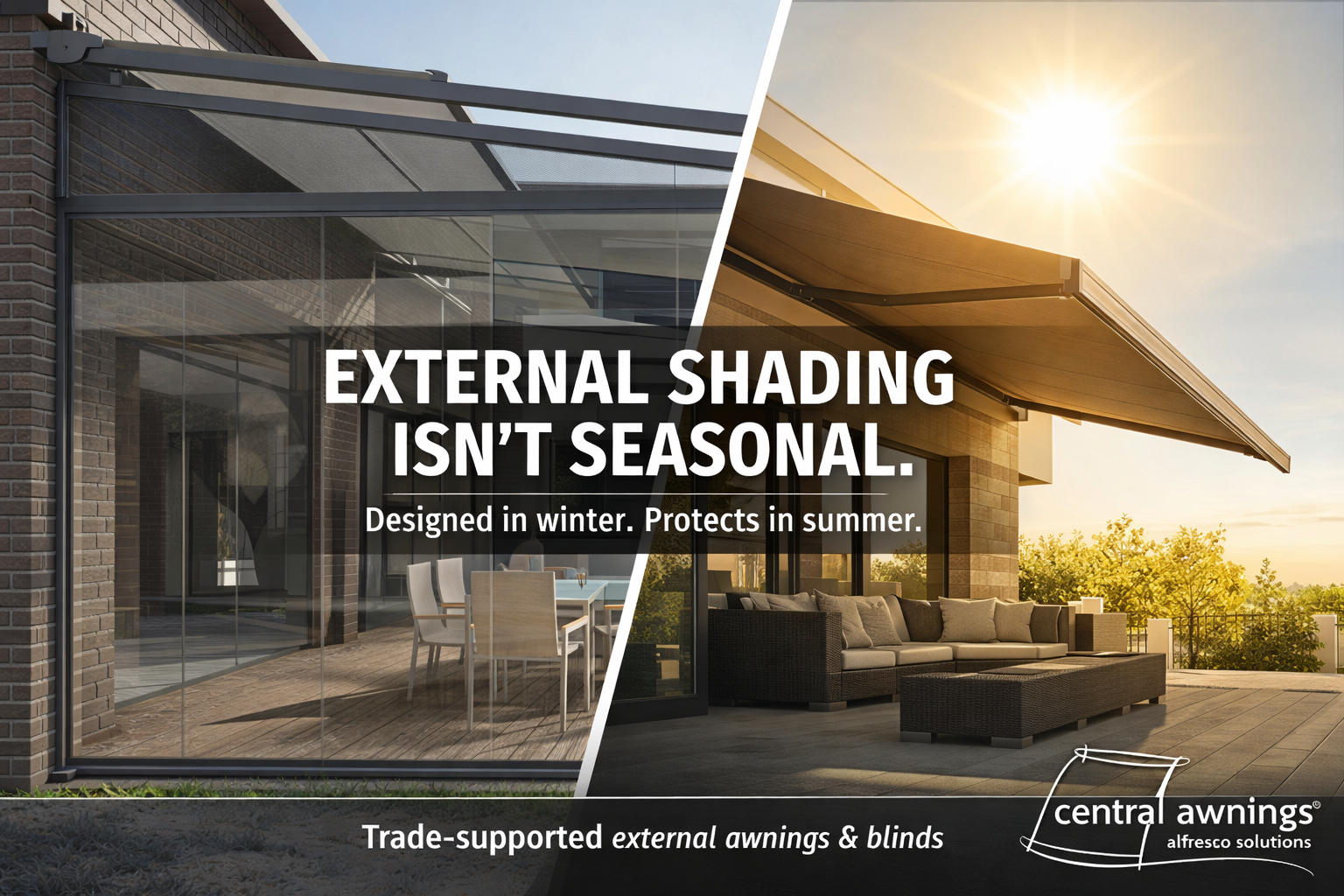
Why External Shading Matters in Winter — and Becomes Essential in Summer
External shading is often seen as a “summer product”. But in reality, the best awning and external blind projects are planned well before the temperature rises.
At Central Awnings, we work exclusively with the trade — supporting installers, contractors and commercial partners with external shading systems designed to perform all year round. And while summer is when shading delivers its most visible benefits, winter is where the planning really should start.
Winter: planning for performance, not panic
During winter months, shading isn’t front of mind — but it should be.
Projects that are specified early benefit from:
Proper site surveys
Correct bracket and fixing design
Consideration of sun paths and exposure
Integration with building access and structure
External shading doesn’t just block heat — it manages solar gain intelligently. South- and west-facing elevations that cause overheating in July are visible problems in January if you know where to look.
Early planning avoids rushed decisions later.
Summer: stopping heat before it enters the building
Once sunlight passes through glass, heat is trapped inside. That’s why external shading is the most effective way to control overheating.
External awnings and blinds:
Block solar radiation before it hits glazing
Reduce internal temperatures naturally
Cut glare without darkening interiors
Protect furnishings and finishes from UV damage
For both domestic and commercial buildings, this means more usable space, better comfort and reduced reliance on mechanical cooling.
Why external shading beats internal solutions for heat control
Central Awnings focuses purely on external systems because they work where the problem starts.
External shading:
Prevents solar gain rather than reacting to it
Supports energy efficiency targets
Improves occupant comfort in homes, offices, hospitality and retail
Offers scalable solutions for large façades and glazed areas
From articulated arm awnings to vertical external blinds, the principle is the same — control heat outside the building envelope.
The trade advantage of early involvement
For installers and contractors, the smoothest projects share one thing: early collaboration.
When shading is considered at design or pre-install stage:
Fixings and brackets are specified correctly
Installation challenges are reduced
End results perform better
Central Awnings exists to support the trade through that process — from system selection to technical advice and build support.
Conclusion
External shading isn’t seasonal — overheating is.(https://www.centralawnings.co.uk/page-16/)
Winter is the best time to plan for summer comfort, and external awnings and blinds remain one of the most effective, low-energy ways to manage solar gain.
The projects that perform best in summer are rarely last-minute decisions.